October Farm Riverfront
Year Acquired: 2016
Size: 47 acres
Miles of Trails: 2 miles on Land Trust Land
Features: Bird and wildlife habitat, a stone canoe house, vernal pools, river views.
Overview
This joint project by the Town of Concord and the Land Trust preserved a beautiful and distinctive landscape, including one mile of frontage on the Concord River. The network of trails affords access to a series of eskers, historic artifacts (a canoe house and cabin foundations), and wooded flood plains. The purchase of October Farm Riverfront was made possible thanks to very generous private donations, the residents of Concord, and a grant from the Commonwealth of Massachusetts. Ownership is divided between the Town (33 acres) and the Land Trust (47 acres).
Trails: Both easy and very steep trails, some seasonal flooding.
Entrances/Parking: Access with parking for seven vehicles is at the end of Ball’s Hill Road off Monument Street. Please park only in the designated area and not on Ball’s Hill Road. The trails cross between Town land and Land Trust land. Please stay on trails and abide by posted signs.
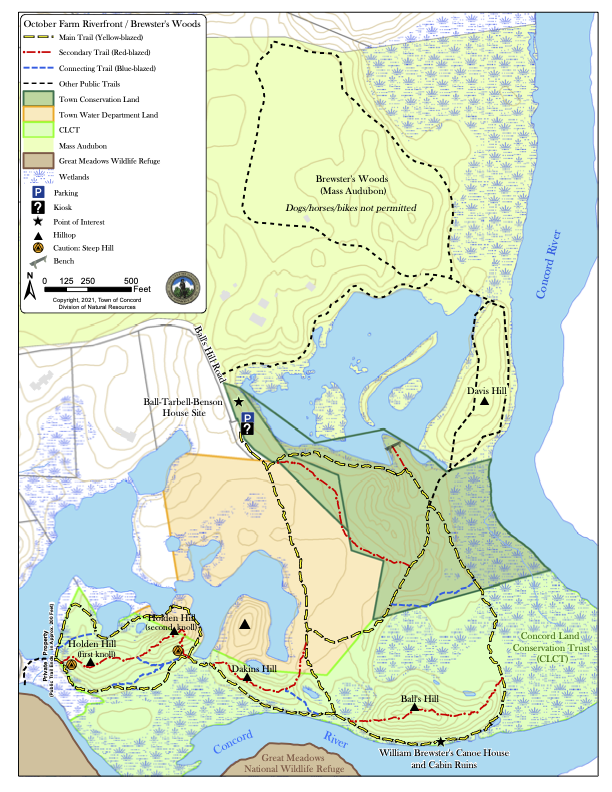
Map Legend

Icons on the map can be clicked to get directions on Google Maps (works best for Parking Icons). Many Land Trust properties have trails that cross onto other land. Please stay on trails and abide by posted signs.
Explore the Land
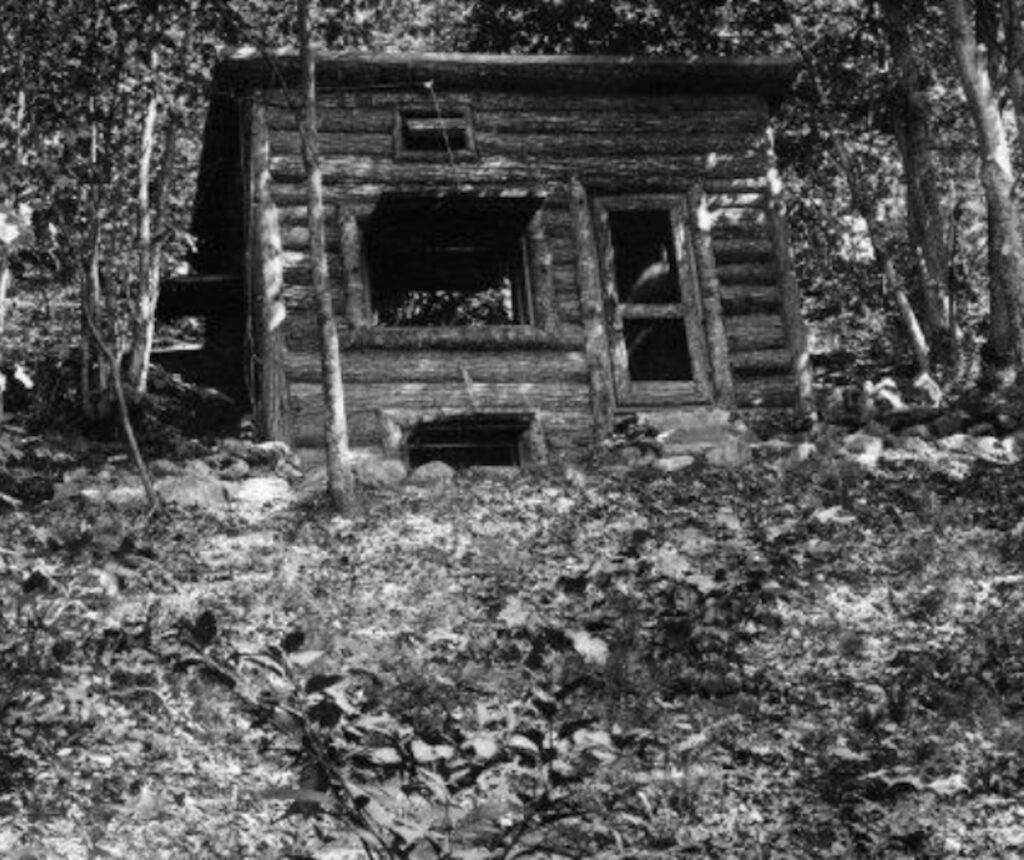
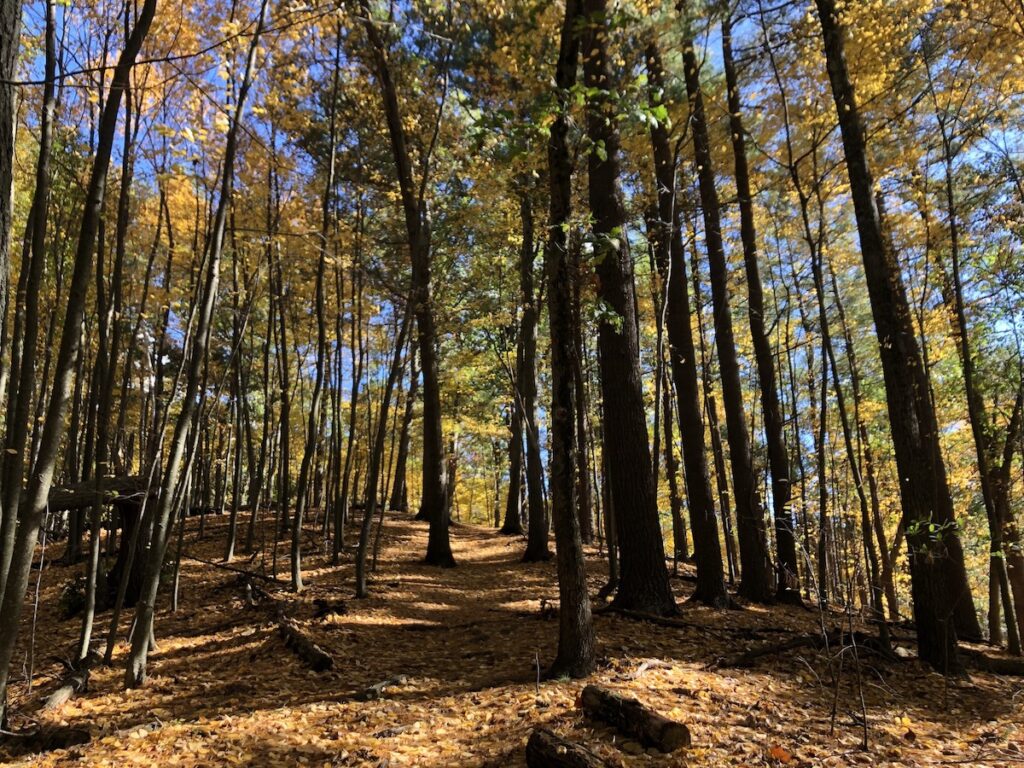
The Land Trust has over 2 miles of trail on this property, not counting the abutting Town trails. The main loop is marked by yellow disks and takes you around the property and along the Concord River. There are secondary trails that explore Holden Hill, Dakins Hill, and Ball’s Hill that are blazed in red and blue. Along the yellow trail, evidence remains of William Brewster’s life on this land. The stone foundations of his cabin and the remains of his fireplace, canoe sheds, and the small boat landing dug into the riverbank can still be seen. “It is my custom,” he wrote in his journal, “when sleeping in the cabin to open a little window by the side of my bed when I first awake to enjoy the early morning singing without the trouble of rising at an inconvenient hour.” More information on Brewster can be found below.
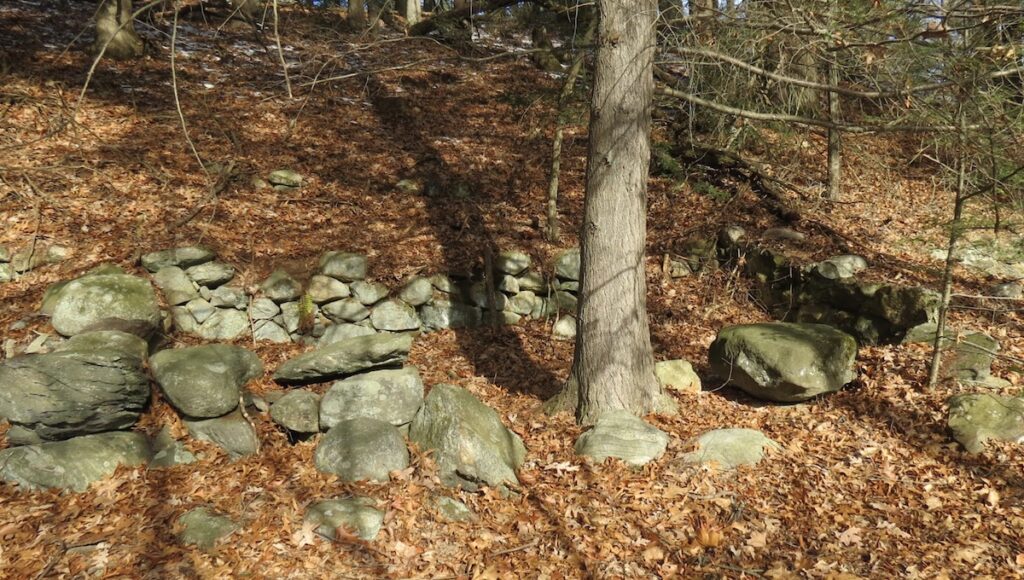
A highlight of the yellow trail are the stone artifacts dating from William Brewster’s ownership of the property. He maintained a few buildings at the base of Ball’s Hill along the Concord River. The stone foundations of the cabin where he entertained guests with food and overnight stays are still visible. This was his private abode and a place for him to observe nature. Just west of the cabin, sheep laurel, catbriar, and shadbush can be found with some intermingled elms, maples, and oaks.
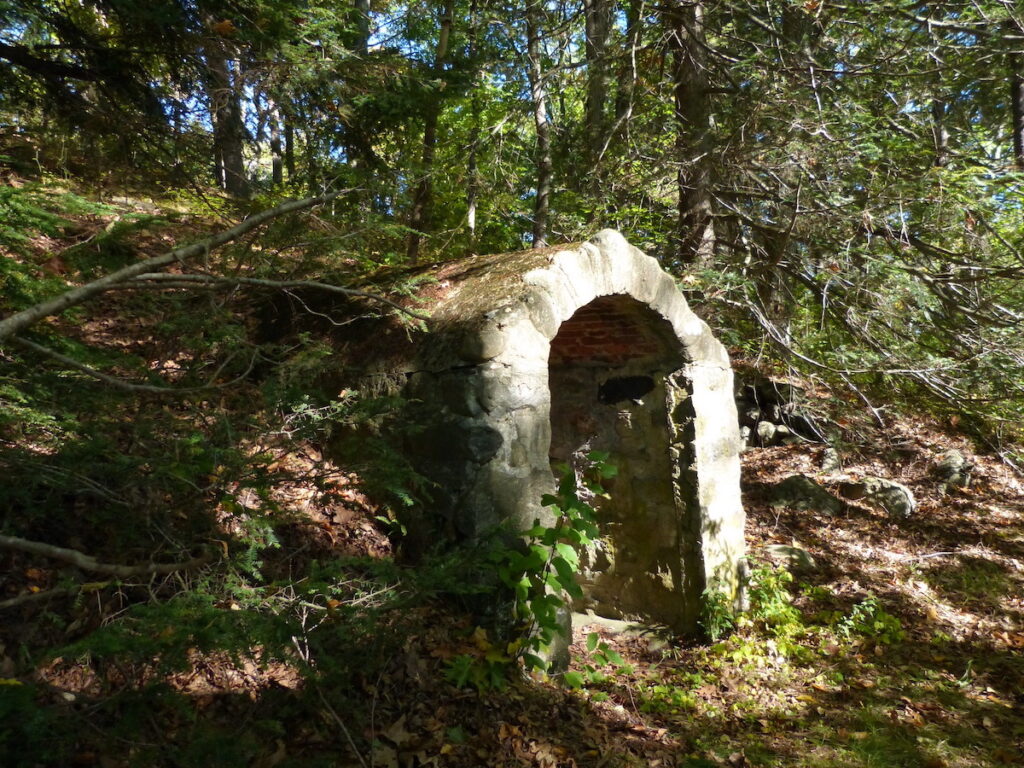
An arched stone structure was built into the hillside next to the cabin that served as Brewster’s boathouse. The structure contains an inscription: “W. B. Sept 1910.” Brewster had the channel opposite the boathouse dug through the riverbank for easier access to the river. His sailing canoe, The Rushton, was stored here.
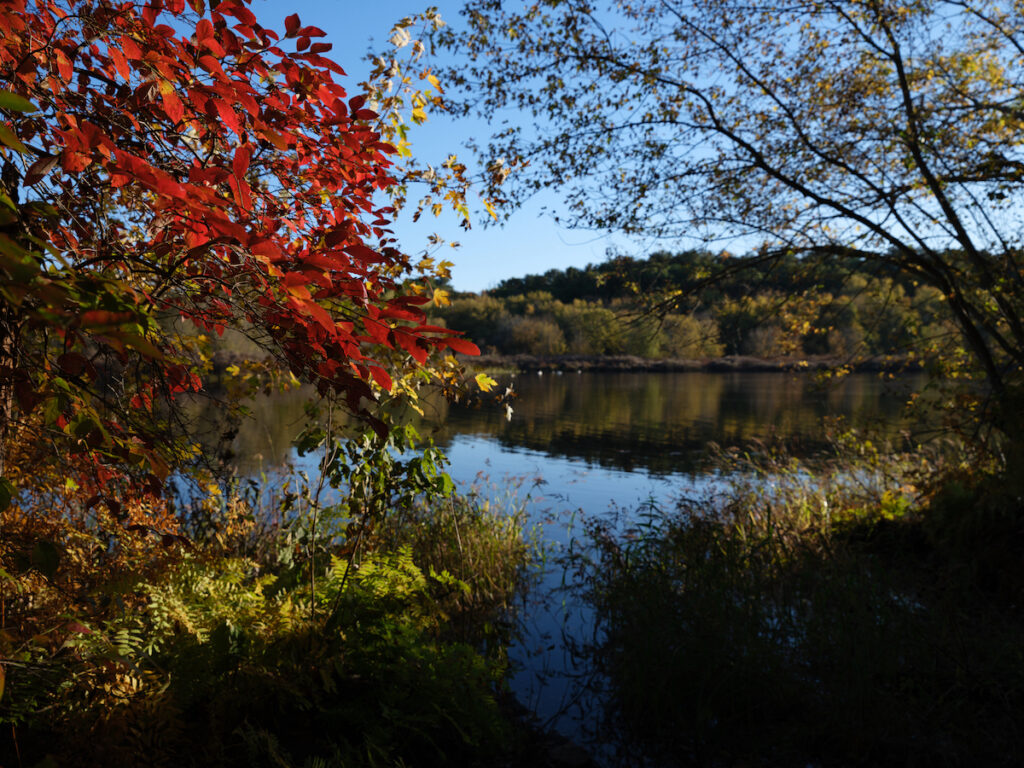
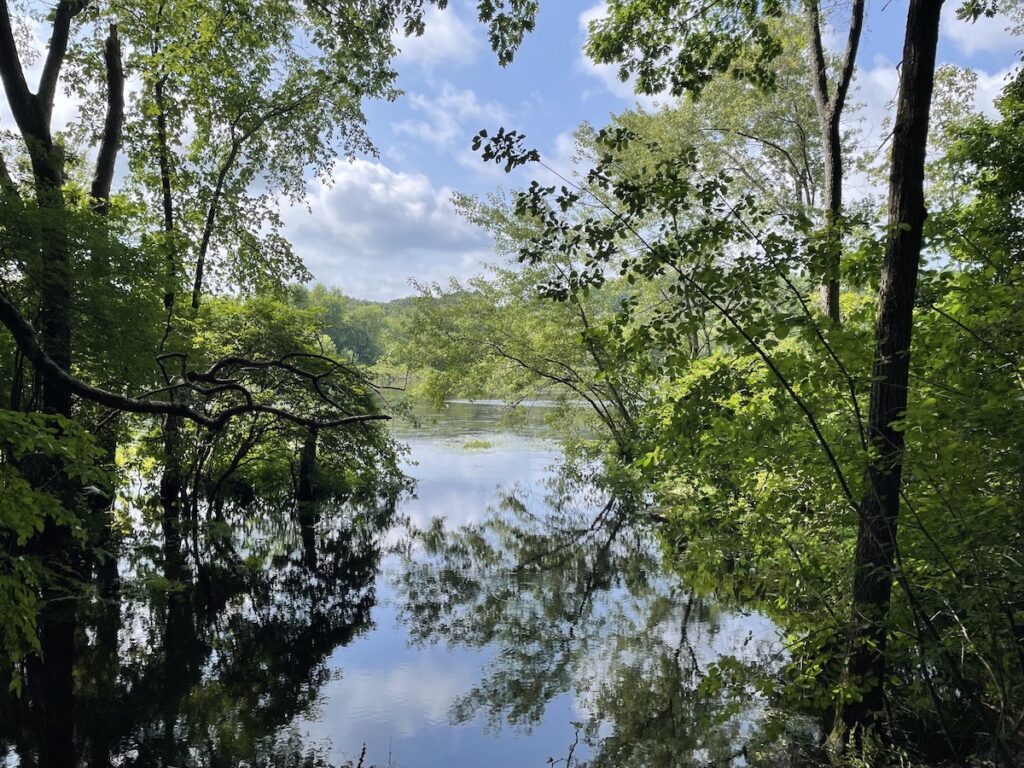
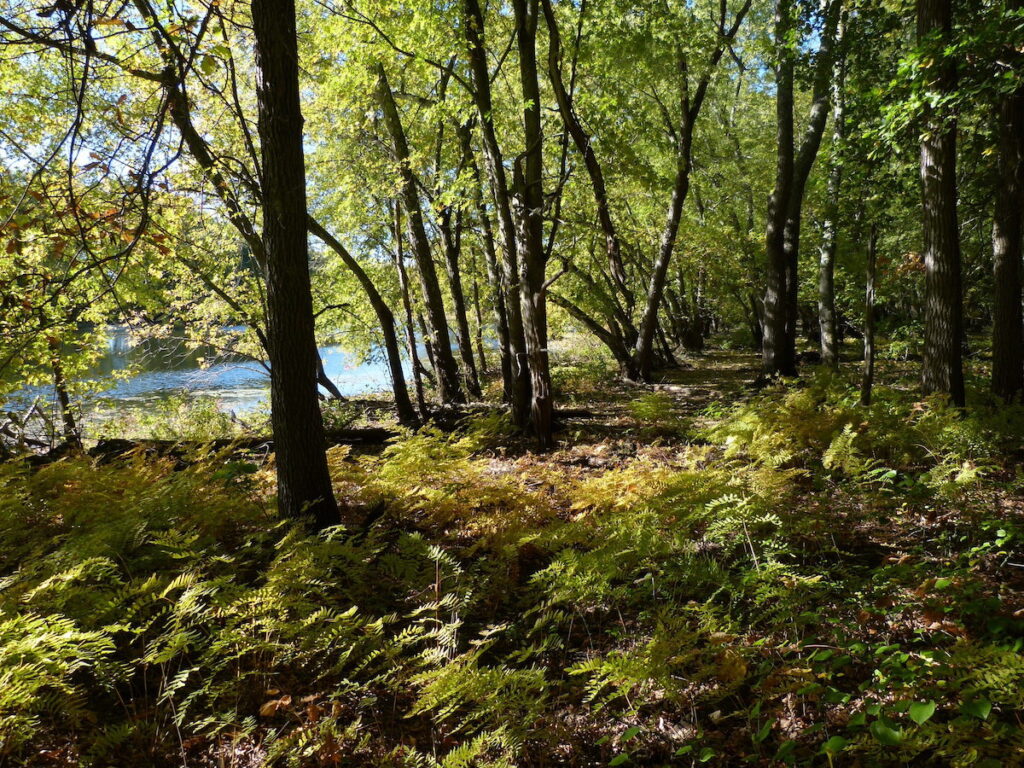
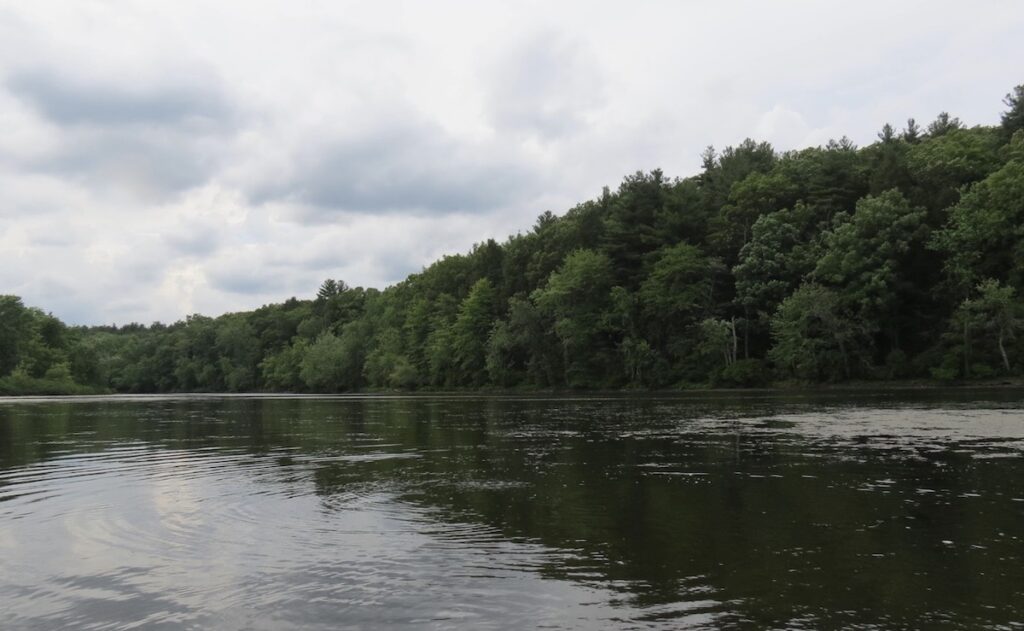
October Farm Riverfront has the most river frontage of any other Land Trust property. It lies on 0.90 miles of frontage which provide habitat to a large variety of species. Historically, the river was helpful for Brewster’s birding trips in Great Meadows and along the river. He used his sailing canoe, equipped with a deck, paddles, and removable mast. The river separates October Farm Riverfront from Great Meadows National Wildlife Refuge. Catbriar, swamp white oak, black tupelo, and river birch line the edges between the trail and the river.
Dakins Hill: Dakins Hill is an esker with nearby vernal pools. These pools have higher water levels than nearby water due to the elevated esker groundwater. There are several double trunk oaks, which have sprouted from stumps after logging. The brush is full of sheep laurel, an evergreen shrub with whitish leaf undersides.
Holden Hill: Holden Hill is an esker of sand and small stones. The steep slope and height provide a sense of elevation and are a target for flying birds. Black birches inhabit the northern slope. These birches lean and curl slightly at the base, due to earlier “soil creep” down the steep slope. There are several scarlet oaks, red oaks, and white pines.
Below Dakins and Holden Hill, a large floodplain extends to the Sudbury River. This area is full of red maples and different types of oak: red, white, black, and scarlet. In the areas subject to flooding, silver maple, sassafras, and ash trees reside on the wet soil.
Ball’s Hill: Ball’s Hill is the highest esker with peeks of the river depending on the season. White birches are abundant, with tall witch hazel and striped maples. Below lies a vernal pool, fed by esker groundwater. In the summer, one can see glimpses of the trail and river below. Once the leaves have dropped, the area opens and one is able to see more of the river.
History of the Land and its Preservation
The forested landscape of hills, ponds, and riverfront seen today was formed 15,000 years ago at the end of the last ice age, when the retreating glacier left its mark on the land around Ball’s Hill. Glacial deposits formed a line of hills that parallels the Concord River along the property’s southern and eastern boundaries. At the southwestern edge, Holden Hill rises sharply from the river, followed by Dakins Hill, and finally Ball’s Hill, the highest.
Long before European settlers arrived here, this area was valued for its rich, varied habitat. It was one of five sites where Algonquin inhabitants hunted, fished, and gathered, and the only one of these five identified in a survey by the Concord Historical Commission as “undisturbed.” Henry David Thoreau made note of the landscapes’ distinctiveness in both books and journals. Shortly after setting out on the voyage recorded in his first book, A Week on the Concord and Merrimack Rivers, Thoreau and his brother stopped to pick late berries on Ball’s Hill before taking leave of Concord from that point, describing the Hill as the “St. Ann’s of Concord Voyageurs.”
At the beginning of the last century, the property became a focus for the observation of wildlife, particularly birds, and the preservation of their habitat. William Brewster bought Ball’s Hill in 1891 to preserve a stand of large white pines and, over a period of years, acquired a total of 300 acres between Monument Street and the Concord River, naming it “October Farm.” The farm’s main house was on Monument Street, but Brewster often stayed in a cabin built on the riverbank at the base of Ball’s Hill. Brewster loved observing bird behavior and listening to their songs. His many volumes of birding journals, excerpts from which were published posthumously in book form as October Farm and Concord River, make the area around Ball’s Hill of special significance. He was the founder of the Nuttall Ornithological Club and the American Ornithologists’ Union, the first president of the Massachusetts Audubon Society, and the longtime curator of an ornithological collection at Harvard’s Museum of Comparative Zoology.
In 2015, 80 acres of the original Brewster property came on the market for residential development. Ultimately, through a bargain sale from the owner, Charlene Englehard, the Land Trust and the Town purchased the property for its historic and ecological value and as a future town well site. When the owner was ready to sell the remainder of her 120 acres in 2018, the Beeuwkes family stepped up and purchased it and then generously donated it to Mass Audubon. The Beeuwkeses had long owned William Brewster’s house on Monument Street and this too they gave to Mass Audubon, retaining a life estate.